
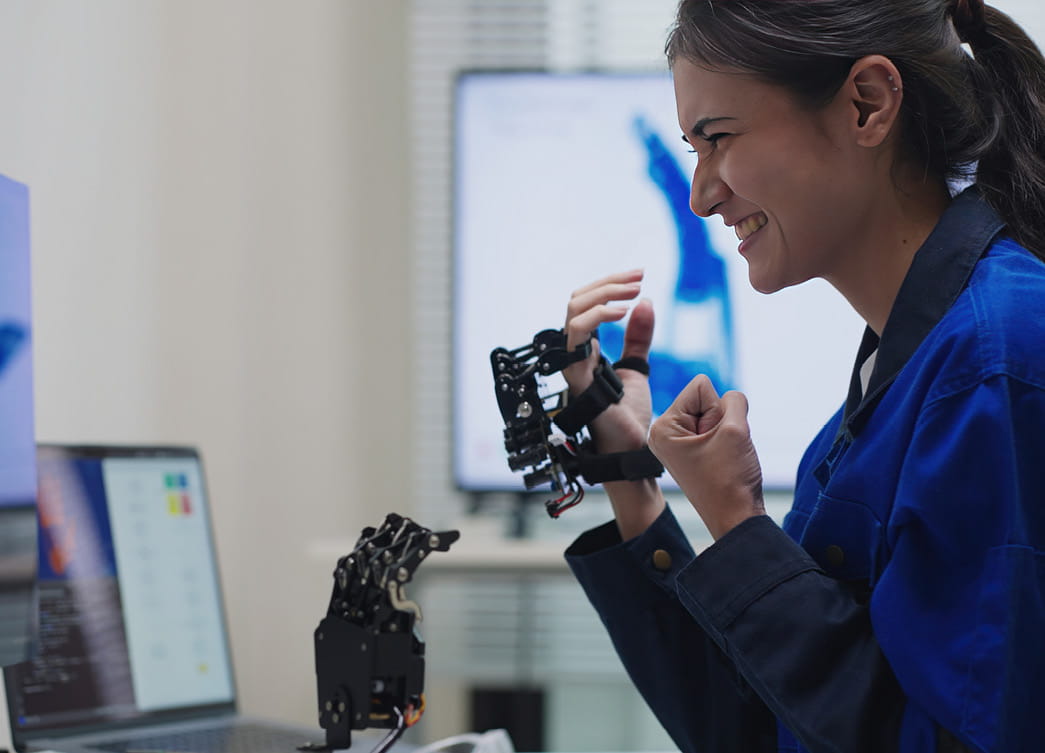
What is an Associate Degree of Engineering (Electronics and Mechatronics)?
An Associate Degree of Engineering (Electronics and Mechatronics) equips you with practical skills in electronics, engineering design and mechatronic systems. You'll apply your knowledge to real-world challenges and build the technical expertise to pursue a career as an Engineering Associate.
Learning outcomes
- Apply mathematics, engineering science and discipline knowledge to defined and broadly defined electronics and mechatronics problems.
- Analyse, test and troubleshoot electronic, embedded, sensing, mechanical and mechatronic systems using appropriate methods and evidence.
- Design and implement components, subsystems and integrated mechatronic solutions within defined requirements and constraints.
- Select and use contemporary laboratory, CAD, manufacturing, programming and engineering tools with attention to validity, safety and limitations.
- Apply systems, risk, sustainability, safety and human-centred considerations to engineering associate-level work.
- Plan and deliver industry-oriented engineering work, contributing effectively in teams and managing defined tasks and resources.
- Communicate technical information, evidence and recommendations effectively to engineering and non-engineering stakeholders.
- Exercise ethical, professional, inclusive and reflective judgement within the scope and accountability of an Engineering Associate.
This course has some subjects that are available for online only study. However, other subjects include assessments and practical tasks that require access to on-campus laboratories at our Adelaide Campus. Please refer to the individual subject outlines for further details. This is an AQF Level 6 course delivered by Torrens University Australia Ltd.
Career opportunities
With this associate degree, you will graduate with the skills to gain employment within the engineering, game development, and wider software engineering industry.
Potential career paths
-
Engineering Associate
Average salary: $70,000 - $204,263 -
Technical Officer
Average salary: $86,728 - $140,240 -
Electronics Technical Specialist
Average salary: $92,500 - $176,626 -
Automation and Instrumentation Specialist
Average salary: $91,698 - $136,072

Subjects and units
Delivered both on campus and online, the Associate Degree of Engineering comprises of 16 core subjects, each subject requiring 10 hours of study per week (made up of classes and self-directed study). Assessments may include activity-based assignments or online quizzes. Please note, some subjects include assessments and practical tasks that require access to on-campus laboratories at our Adelaide Campus. There are no formal exams.
Requirements
Core subjects
-
Engineering Design and Professional Practice | ENG101
-
Programming for Engineers | ENG102
-
Engineering Mathematics 1 | ENG103
-
Physics for Engineers | ENG104
-
Electronic Systems and Prototyping | ENG105
-
Robotics and Industrial Automation | ENG106
-
Industrial System Project | ENG107
-
Automation, Innovation and Enterprise | ENG108
Applicants may be required to undertake ENG099 where additional mathematics or other foundational knowledge is required. This is a 0 credit point subject.
-
Preparatory Engineering Mathematics | ENG099
Requirements
Core subjects
-
Engineering Mathematics 2 | ENG201
-
Engineering Mechanics: Statics and Dynamics | ENG202
-
Analogue Electronics and Circuit Analysis | ENG203
-
Digital Electronics and Embedded Systems | ENG204
-
Instrumentation and Sensing Systems | ENG205
-
Engineering Materials, Manufacturing and CAD | ENG206
-
Mechatronic Systems Design and Integration | ENG207
-
Engineering Practice Project | ENG208
Study pathways
Torrens University offers undergraduate and postgraduate students with flexible entry options and study pathways. Whether you prefer a full program or a modular approach, we can tailor your studies to your needs. Start your journey with an undergraduate diploma or bachelor degree, or grow your career with a postgraduate qualification.
Need more help?
Let us customise a study plan and pathway for you.
Undergraduate
-
Diploma courses ( 3 options )
-
View course
Undergraduate Certificate of Engineering
Domestic students only
-
View course
Diploma of Engineering Electronics and Mechatronics
Domestic students only
-
View course
Associate Degree of Engineering Electronics and Mechatronics
Domestic students only
-
-
Bachelor courses ( 2 options )
-
View course
Bachelor of Engineering Technology Electronics and Mechatronics
Domestic students only
-
View course
Bachelor of Engineering Honours Electronics and Mechatronics
Domestic students only
-
Entry details
Fees
Check the domestic course fee schedule for the cost of your course.
FEE-HELP
Eligible Australian students may choose to defer some, or all, of their tuition fees through FEE-HELP, a loan scheme repaid through the tax system based on income.
Scholarships
If you are truly passionate about Technology, we want to hear from you. We have a variety of Technology scholarships on offer to assist you in becoming a key part of the Technology industry:Admission criteria
Before you begin your application to study as a domestic student, check that you meet at least one of the requirements listed below.
Australian secondary school certificate, or equivalent
OR
Successful completion of a Vocational qualification (AQF Level 4), or above
OR
Successful completion of at least 0.5 EFTSL at AQF 5 from an Australian University or a registered higher education provider
OR
Successful completion of at least 0.25 EFTSL at AQF level 6, 1 EFTSL at AQF level 5 or above, or equivalent
OR
Work life experience demonstrating the ability to undertake study at the required level which may include approval of prior study or successful completion of a readiness assessment. Applicants may be required to undertake preparatory study where additional mathematics or other foundational knowledge is required.
You can apply for this course without an ATAR. We take a broader approach to entry, so more people have the opportunity to study at university.
Guaranteed pathway and Recognition of Prior Learning
If you have already completed a qualification or gained skills through life or work experience, you may be able to credit this against your degree with us. Check information about Recognition of Prior Learning and Course Credit transfer. We also offer pathway opportunities to further your learning.How to apply

Get started
Read through the admissions criteria and ensure you meet the entry requirements.

Expression of Interest
Contact us to submit an Expression of Interest and our team will be in touch with you.

Stay informed
Our team will contact you once enrolments open and guide you through the application process.
Frequently asked questions
-
What are Torrens University Australia’s ATAR requirements for domestic students?
-
What if I don’t meet the entry criteria for a degree?
-
Am I eligible for FEE-HELP?
-
Can I get course credit for previous experience?
-
What are Recognition of Prior Learning (RPL) and Credit Transfer (CT)? How do I apply?
-
How do I apply for a scholarship?
Similar courses

Undergraduate Certificate of Engineering

Diploma of Engineering (Electronics and Mechatronics)
Bachelor of Engineering Technology (Electronics and Mechatronics)

Bachelor of Engineering (Honours) (Electronics and Mechatronics)

Want to find out more?
Don't forget to download the course guide or get in touch with us below.