
Is your wardrobe full of promise? How many clothes you need

Most people want to live sustainably, but when it comes to fashion, they are often unsure where to begin.
Clothing has become increasingly affordable and accessible, with new products marketed daily across physical and digital retail environments. Australians are estimated to purchase 56 new items of clothing each year, contributing to wardrobes that continue to grow despite increasing awareness of fashion's environmental impacts.
How much clothing do Australians buy and throw away?
The consequences of this growth extend well beyond individual wardrobes. Charitable organisations and textile recovery systems often struggle with the volume of unwanted clothing entering donation streams. While some garments are resold or reused, significant proportions ultimately end up discarded or are exported to overseas markets. In Australia alone, approximately 220,000 tonnes of clothing are estimated to end up in landfill each year.
Much of the public conversation around sustainable fashion focuses on reducing purchasing. People are encouraged to buy less, declutter regularly, build capsule wardrobes, or resist trend-driven purchasing. While these approaches are valuable, they often overlook a fundamental question: are the clothes already sitting in our wardrobes being worn enough to realise their value?
This question is particularly important because clothing carries embedded environmental resources from the moment it is produced. Every garment represents an investment of materials, labour, energy and water. Maximising the use of existing clothing therefore remains one of the most effective ways individuals can reduce the environmental impact of their wardrobe.
As a certified B Corp, Torrens University recognises that sustainability is not only about innovation but also about empowering people to make informed decisions in their everyday lives. Research undertaken within the university's fashion design discipline has led to the development of the Wardrobe Maths Calculator, a free tool devised to help people better understand the relationship between wardrobe size, wearing frequency and clothing longevity.
Why “how many clothes should I own” has no single answer
There is no shortage of advice about how to build a more sustainable wardrobe. Cost-per-wear calculations, the 30 Wears Challenge, capsule and minimalist wardrobes have all contributed valuable ideas to the sustainability conversation. However, each approach has limitations.
Cost per wear encourages people to calculate the financial value of a garment by dividing its purchase price by the number of times it is expected to be worn. This can be particularly useful for higher-priced garments because it highlights the advantages of durability and long-term use. However, the approach can be less effective when applied to inexpensive clothing. Further devaluing low-cost garments, which still carry significant environmental impacts. Resource use is rarely determined by price alone.
Similarly, the 30 Wears Challenge has played an important role in encouraging people to extend garment lifespans. However, the challenge is not based on garment-specific utilisation requirements. Different garment categories require very different levels of use before their environmental impacts can be justified, and most minimums are well above 30 wears. For example, the European Commission's Product Environmental Footprint rules (PEFCR) for apparel and footwear propose a minimum of 100 wears for a winter coat.
Capsule wardrobes and minimalist wardrobes offer another popular solution. A carefully curated collection of versatile garments can simplify dressing and potentially reduce future purchasing. However, these approaches provide limited guidance for people who already own larger wardrobes. Questions inevitably remain: How many garments should be retained? Which items should stay? What should happen to the pieces that are removed?
What these approaches often have in common is a focus on wardrobe size rather than wardrobe use.
How the sustainable Wardrobe Maths Calculator works
The Wardrobe Maths Calculator was developed to address this gap.
Rather than telling people how many clothes they should own, the calculator reveals the minimum number of wears already committed to through the garments they have acquired. It reframes clothing ownership as a commitment to future use.
The calculator uses minimum wear benchmarks derived from European PEFCR rules as the basis for its calculations. Users enter the number of garments they own in different categories, such as dresses, jackets or shorts. They then record how often each type of garment is worn and identify the number of seasons in which it is typically used.
Using this information, the calculator estimates how many years it would take for those garments to achieve their minimum wear potential.
The results often reveal a mismatch between the types of garments acquired and typical use patterns. In many cases, garments are purchased at a faster rate than they can realistically be worn. The calculator therefore helps identify purchasing patterns that are not aligned with actual wearing behaviour.
Importantly, the tool is not designed to judge, shame or prescribe. Instead, it provides information that helps people make more informed decisions about wardrobe management. It also encourages users to revisit and reappreciate garments that may have been forgotten, hidden at the back of a wardrobe, or overlooked in favour of newer purchases.
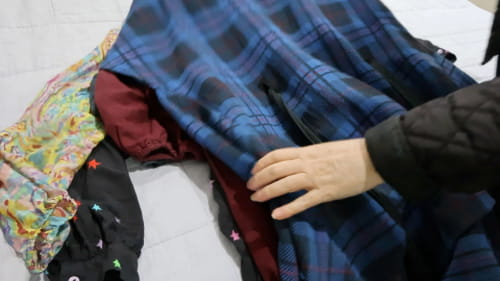
What happens when a wardrobe is put to the test?
The calculator's value becomes particularly apparent when applied to real wardrobes.
One wardrobe analysed during development of the tool contained 203 major garments, placing it slightly above average compared to recent international wardrobe studies. However, the total number of garments proved far less important than the relationship between quantity and use.
The results for three garment types show why:
| Garment type | Quantity Owned | How often this type of garment is worn | Number of Seasons Worn | Result |
|---|---|---|---|---|
| Dresses | 37 | 3 wears per week | 4 | 16.6 years to wear each a minimum 70-wears |
| Tops | Close to 50 (across 3 categories) | Twice a week - everyday | 4 | Within an achievable range (2.7-3.5years) |
| Jumpsuits | 3 | Once a month | 2 | 35 years to reach minimum wear targets |
Perhaps most revealing was the jumpsuit result: even low garment quantities can still create sustainability challenges. Whereas the tops which at first seemed excessive stayed within a more achievable range because they were worn so often.
The examples demonstrate that sustainability is not determined by wardrobe size alone. Rather, it is the combination of quantity and frequency of use that ultimately determines whether garments achieve their intended value.
While it is not impossible for clothing to remain in use for decades, such outcomes become increasingly unlikely over time. Body shapes can change, lifestyles evolve, personal tastes shift, and garments inevitably experience wear and tear. Understanding these realities helps people make more realistic decisions about future purchases.
From wardrobe size to wardrobe use: What to do next
Sustainability is often discussed through statistics about waste, emissions and overconsumption. While these figures are important, they can feel disconnected from everyday decision-making.
The Wardrobe Maths Calculator translates these broader sustainability challenges into a practical, personal and measurable format. By helping individuals understand the relationship between what they own and what they wear, it transforms abstract concepts into meaningful insights.
Greater awareness of wardrobe use patterns can support better purchasing decisions, encourage longer garment lifespans, and highlight alternatives such as borrowing, renting or swapping for items that are only required occasionally.
The calculator also contributes to ongoing research. Anonymous user submissions are helping build a broader understanding of clothing ownership, wardrobe volume and wearing behaviour across diverse populations. This data has the potential to inform future research into clothing longevity and sustainable wearing practices.
Ultimately, the Wardrobe Maths Calculator shifts the conversation away from asking how many clothes people should own and towards a more meaningful question: can the clothes already hanging in our wardrobes realistically achieve their intended value? By making those commitments visible, the calculator transforms sustainability from an abstract aspiration into a practical aspect of everyday life.

Related articles


