
Students turn trusted data into opportunities for veteran wellbeing

What can data reveal about the wellbeing of Australia's veterans, and how can those insights help inform better decisions?
These were the questions at the centre of “Understanding Veteran Wellbeing. Informing better decisions” a 12-week industry project undertaken by our Master of Business Analytics students.
Working with a client team including representatives from Salesforce, Simple Healthcare Solutions and RSL Henley and Grange, students were asked to make sense of information relating to veteran wellbeing following the Royal Commission into Defence and Veteran Suicide.
The project brought together four trusted, publicly accessible data sources:
- Australian Institute of Health and Welfare (AIHW) health and wellbeing data
- Department of Veterans' Affairs (DVA) data
- Australian Bureau of Statistics (ABS) population data
- Royal Commission (RC) data capturing veteran experiences
The result was a substantial data analytics project combining quantitative insights, qualitative analysis, and visual storytelling.
Turning complex data into meaningful insights
Over 12 weeks, the student team, mentored by academic leaders, worked through a three-stage process.
First, they selected the information most relevant to understanding veteran wellbeing. They then prepared, cleaned and collated the data into usable formats before verifying the information and analysing it for patterns, outliers and connections between different sources of evidence.
Building a trusted data foundation for veteran wellbeing
Bringing trusted data together to create meaningful insights.

The team analysed 2,118 testimony excerpts to better understand lived experiences reflected in the Royal Commission data. From the publicly available data sources, they developed a series of dashboards for the client, exploring veteran demographics, wellbeing, suicide risk, healthcare use and potential service gaps.
Using Tableau, AI-supported tools, Streamlit and other data analytics technologies, students created:
- Eight dashboard chapters
- A written report
- A Streamlit insights report
- An AI-supported chatbot
- A qualitative analysis of veteran testimony
- A presentation for the client
- Five priority opportunities to support future action
The students used AI as an assistant for repetitive tasks while preserving the underlying information and applying team-based verification processes to check the accuracy and integrity of the outputs.
This project gave students the opportunity to apply their technical knowledge to a real-world issue, collaborate with industry, and produce work with potential policy and community impact
Dr Hayden McDonald, Torrens University Business Administration Program Director

Learning to work with complex data and tools
The project required students to work with multiple datasets, formats and perspectives. They needed to coordinate responsibilities across a large team, learn unfamiliar tools and combine quantitative evidence with personal accounts of lived experience.
The team also had to respond to detailed feedback and significantly improve its dashboards and final presentation within one week.
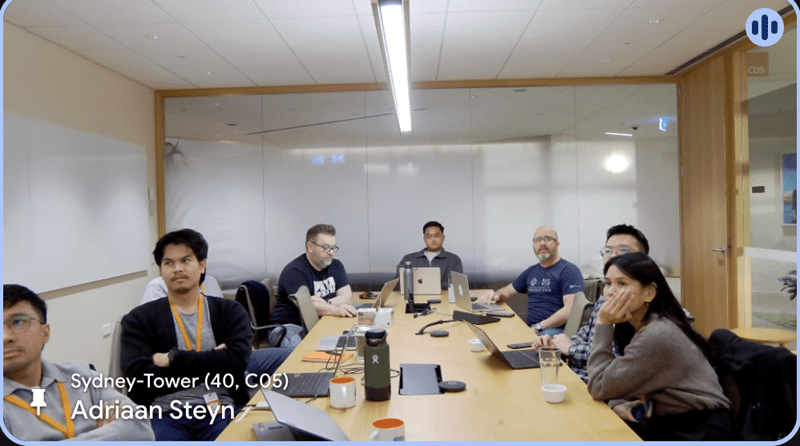
These challenges reflected the realities of professional data analytics, where analysts need to work collaboratively, verify information carefully and communicate findings clearly to different audiences.
Industry partners were impressed by the students' ability to translate complex evidence into a clear and accessible story.
The students told a great story with their presentation. They used validated, grounded and trusted data sources to communicate complex findings in a way that was simple to understand.
Adriaan Steyn, Salesforce
The students' work was incredibly impressive. The quality of the analysis, the AI tools and chatbot they developed, and the way they communicated their findings demonstrated a level of capability well beyond what we expected.
Dane Pamuspusan, Salesforce
From insight to opportunities for veterans
The project was not simply about presenting data. It explored how evidence could support better decisions and more targeted responses for veterans, families, healthcare providers, community organisations and policymakers.
The students identified five priority opportunities for further consideration, drawing on evidence from both the quantitative datasets and veteran testimony.
Their work may help inform future conversations involving communications teams, policymakers, RSL organisations, VetForce, healthcare providers, general practitioners and community services.
The project also demonstrated the potential of ongoing industry collaboration. Torrens University and Salesforce, amongst other industry partners regularly work together on client projects across the academic year, giving students opportunities to apply their developing expertise to authentic organisational and community challenges.
For the analytics team lead Kaushalya Muthuthanthri, the experience provided an opportunity to work on a project with genuine social significance.
It has been an amazing opportunity to work with Salesforce on a project of this magnitude. Over three months, we received valuable support and guidance while developing our skills and working together on an issue with genuine social impact.
Kaushalya Muthuthanthri, Torrens University student
Behind every data point is an actual person, and behind every insight is an opportunity to make support more targeted and meaningful. We were honoured to work on this project.
The team's closing remarks captured the purpose behind the project
Building analytics skills for real-world impact
Through projects such as Understanding Veteran Wellbeing. Informing better decisions, students in the School of Technology develop more than technical capability.
They learn how to work with complex datasets, use emerging technologies responsibly, collaborate with industry partners, and communicate insights in ways that can support meaningful action.
By connecting data with lived experience, the project showed how business analytics can contribute to conversations across health, policy, technology, and the community.
Related articles


